Note 10 Writing
(Last updated: 10/28/2026)
1. What is writing
- Distinction between
- Language practice using writing
- Fill in blanks
- Short answer questions (e.g., at the sentence level)
- Writing for communication: Negotiation of meaning
- Language practice using writing
- Introduction: https://www.youtube.com/watch?v=xXMdOYJ7G6Q
- What abilities does writing involve?
- Grammatical ability
- Lexical ability
- Mechanical ability
- Organizational ability
- Judgments of appropriateness
- Others
2. Teaching writing
2.1 Writing tasks
2.1.1 Where to start
- Functional approach: Expressions of thanks, requirements, etc.; Eliciting information such as directions, services, etc.;
- Type/register of texts: Letter/announcement, note/narration, argument/description, forms, and instructions, etc.;
- Topics: Social interaction, visiting places of interest, studying for academic purposes, etc.
- Question: What kind of tasks are appropriate for beginning level students?
- https://www.youtube.com/watch?v=vRJuwzCfix4
- https://www.youtube.com/watch?v=1pE-ohVy9e0
2.1.2 How to control
2.1.2.1 The basic writing skills training: Structured output
c.f. https://forlang.fsa.mtsu.edu/fl5500/notes/2026_note6.html
Select the answer based on information you read/hear.
I got up late and didn’t have time for breakfast. After coming back from school at 11am, I cooked my own lunch and ate it in 10 minutes.
I had no breakfast because I ___________ late.
a) went to school
b) got up
c) cooked lunchNow describe in order what the person did in the morning.
I ____________ and then ____________. I ________ home at 11am and ___________.
2.1.2.2 Guided
c.f. http://www.learner.org/workshops/tfl/resources/s3_teachingwriting2.pdf (note: the link is dead as of 11/3/2020)
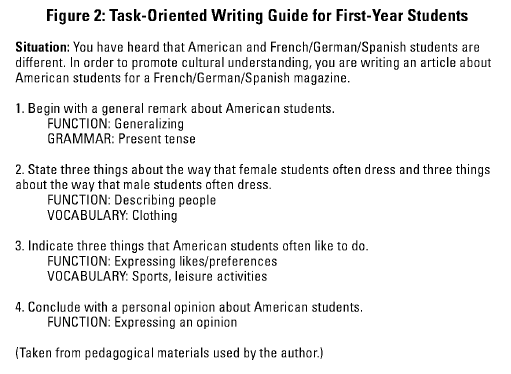
2.1.2.3 Open-ended (free style)
c.f. the situation section of the above task.
2.2 The writing process
c.f. http://coerll.utexas.edu/methods/modules/writing/02/sets.php
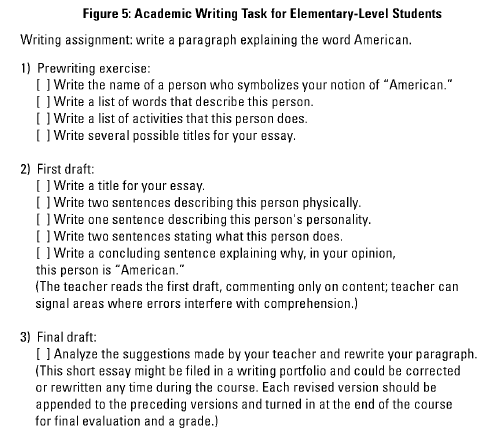
- Pre-writing activities
- Brain storming
- Prompts
- Instructions
- Draft
- Revision
- Feedback
- Rewriting
2.3 Evaluation
2.3.1 Types of scoring and rubrics
c.f. http://coerll.utexas.edu/methods/modules/writing/04/scoring.php
- Analytic
- Holistic
- Primary trait
Question: When to use which type of scoring in your class?
2.3.2 The State of TN
- Can be adapted for foreign languages: https://www.tn.gov/education/districts/lea-operations/assessment/tcap-writing-rubrics.html
2.3.3 Your own rubrics
Each writing class has its own objectives. Just google 'ESL writing rubrics' and you should find many samples that can be adapted for your own class.
2.4 An experiment with ChatGPT
You don't have to turn it in but it is worth the trouble to experiment!
Describe to ChatGPT that you are teaching Spanish (or French...) 1010 in a college and at the end of the first semester, students are expected to reach the novice-high level (ACTFL Proficiency levels). Ask ChatGPT to come up with two sets of rubrics, one for analytic scoring and the other holistic scoring. Examine the two sets of rubrics first and then ask ChatGPT to explain to you the differences between the two (if it hasn't done so already).